
St. Tammany Succession Records
Probate in St. Tammany Parish is handled through Louisiana civil practice. The research does not show a separately branded probate court, surrogate court, or orphans' court for the parish. Instead, succession and tutorship matters are filed as civil matters in the 22nd Judicial District Court and maintained by the St. Tammany Parish Clerk Civil Department. The Civil Department expressly lists successions and tutorships among the case records it processes and maintains, along with civil suits, domestic matters, adoptions, commitments, and appeals.
A St. Tammany Parish succession file can contain the papers used to settle a deceased person's estate. Depending on the case, the probate record may include a petition, will, codicil, death documentation references, affidavits of death or heirship, a descriptive list or inventory, notices, executor or administrator paperwork, and a proposed or signed judgment. When immovable property is part of the estate, the final judgment of possession may also be recorded in the Clerk's land records because the judgment helps transfer real estate interests.
The Clerk's official department page is useful because it separates the record path by function. Civil handles the court case. Land Records handles conveyance and mortgage records, including judgments of possession. Archives handles older genealogy and historical material. That split keeps a St. Tammany Parish probate records search from stopping too soon when one portal does not show every estate-related document.
The Clerk Civil Department source identifies the filing home for successions and tutorships.
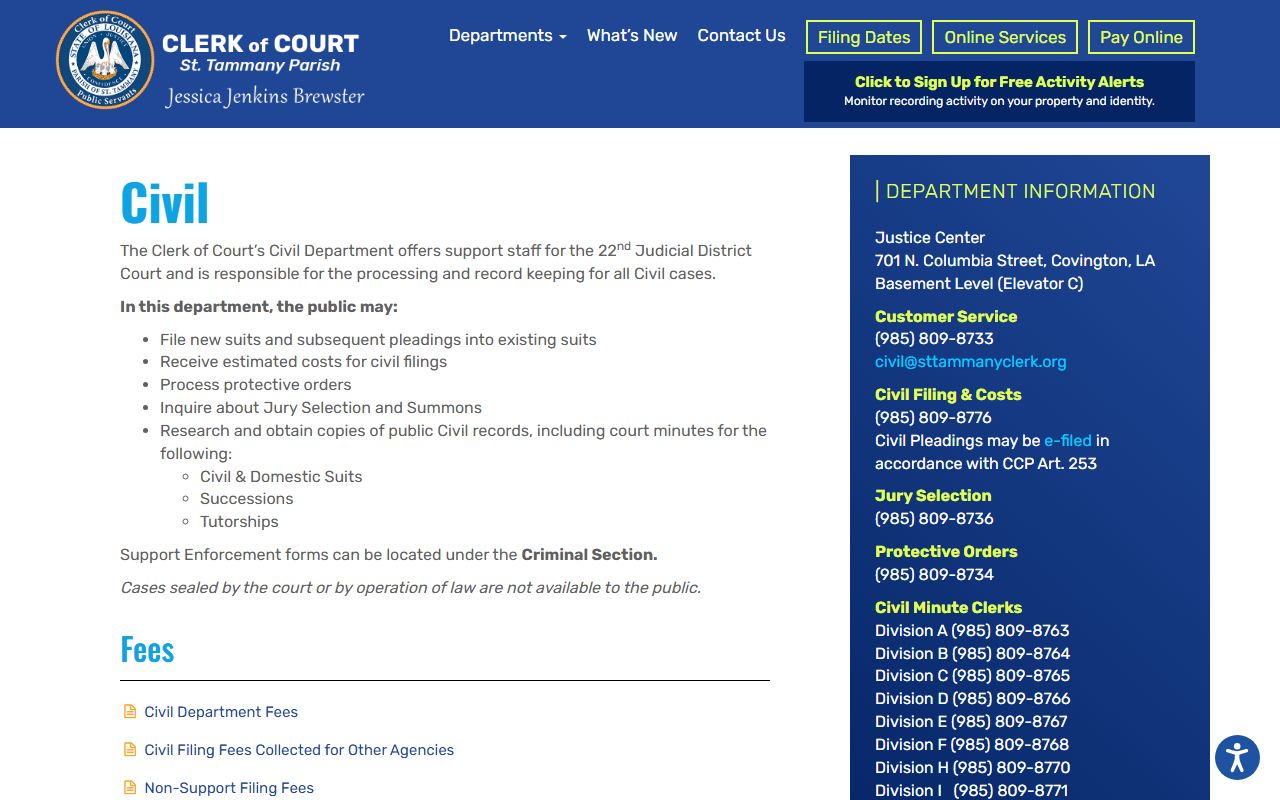
That Civil Department connection is why St. Tammany Parish probate matters should be searched as District Court civil records first, then checked against land or archive channels when the estate has older or property-related material.
St. Tammany Probate Terms
Louisiana probate language differs from many states. A reader looking for "probate" may need to search for succession or tutorship in St. Tammany Parish court records. These terms help identify the right case type, especially when searching re:SearchLA, calling the Clerk Civil Department, or asking Archives for an older file.
- Succession
- The Louisiana estate proceeding used to transfer a deceased person's property to heirs or legatees.
- Judgment of possession
- A court judgment that places heirs or legatees in possession of estate property; it may also appear in land records.
- Testator
- The person who made a will.
- Executor
- The person named to carry out a will or manage estate work after appointment.
- Intestate
- Dying without a valid will, which means Louisiana succession law controls who inherits.
- Tutorship
- A civil court matter involving authority over a minor; it is the local term to use instead of generic guardianship.
Some older templates and out-of-state forms use words such as guardian or conservator. In St. Tammany Parish, the researched Clerk materials point to tutorship and succession as the safer local terms for probate-style searches.
Search St. Tammany Probate Records
Current St. Tammany Parish succession and tutorship case searches start with the same Clerk-backed court-record path used for civil matters. The Clerk's online-services page directs users to re:SearchLA for civil and criminal court records. Older records, e-certification for court records entered before 4/25/19, land records, marriage licenses, and archive material route through the Clerk legacy portal. Certified copies and hard-to-find files require the Clerk Civil Department or the public counter.
- Search by decedent name, party name, or case number in re:SearchLA when the succession or tutorship is a current public civil case.
- Choose St. Tammany Parish or the 22nd Judicial District if the portal offers a location filter, then narrow by filing date or civil case type when those fields appear.
- Check the docket for petitions, orders, judgments, hearings, and division assignment. Full document access may require account permissions or fees.
- Use the Clerk legacy portal when the case is older or when the document is tied to land records, archives, or court e-certification before 4/25/19.
- Call or visit the Clerk Civil Department for certified copies, paper files, restricted-file questions, or records that do not appear online.
| Search Field | Best Use | Notes |
|---|---|---|
| Decedent or party name | Name search | Use when the civil case number is unknown. |
| Case number | Exact lookup | Best path for a known succession or tutorship file. |
| Case type | Filter results | Look for succession, tutorship, civil, or related labels. |
| Filing date range | Narrow recent estates | Useful when common family names produce many results. |
| Land-record instrument number | Property outcome | Use for a recorded judgment of possession. |
Note: If the online case search returns no result, the file may be older, restricted, not indexed under the expected name, or held in a department-specific record set.
St. Tammany Probate Offices
St. Tammany Parish probate matters use the District Court and the Clerk of Court rather than a separate probate court. The main public access point is the Clerk's Covington office at the St. Tammany Parish Justice Center. The Slidell Annex gives east-parish users another Clerk counter, although the specific service should be confirmed before travel. Archives may be the more useful contact for old succession and genealogy work because the Clerk states that the Archives Department preserves parish history and genealogy dating back to 1810.
Clerk Civil Department
701 N Columbia Street
Covington, LA 70433
985-809-8700
Monday-Friday, 8:30 a.m.-4:30 p.m.
Clerk Slidell Annex
520 Old Spanish Trail, 5th Floor
Slidell, LA 70458
985-643-6969
Monday-Friday, 8:30 a.m.-4:30 p.m.; closed 1:00 p.m.-2:00 p.m.
Clerk Archives
St. Tammany Parish Clerk of Court
Historical and genealogy records back to 1810
985-809-8700
Use for older succession and family-history research.
The Clerk Archives source supports the older-record path for St. Tammany Parish probate research.
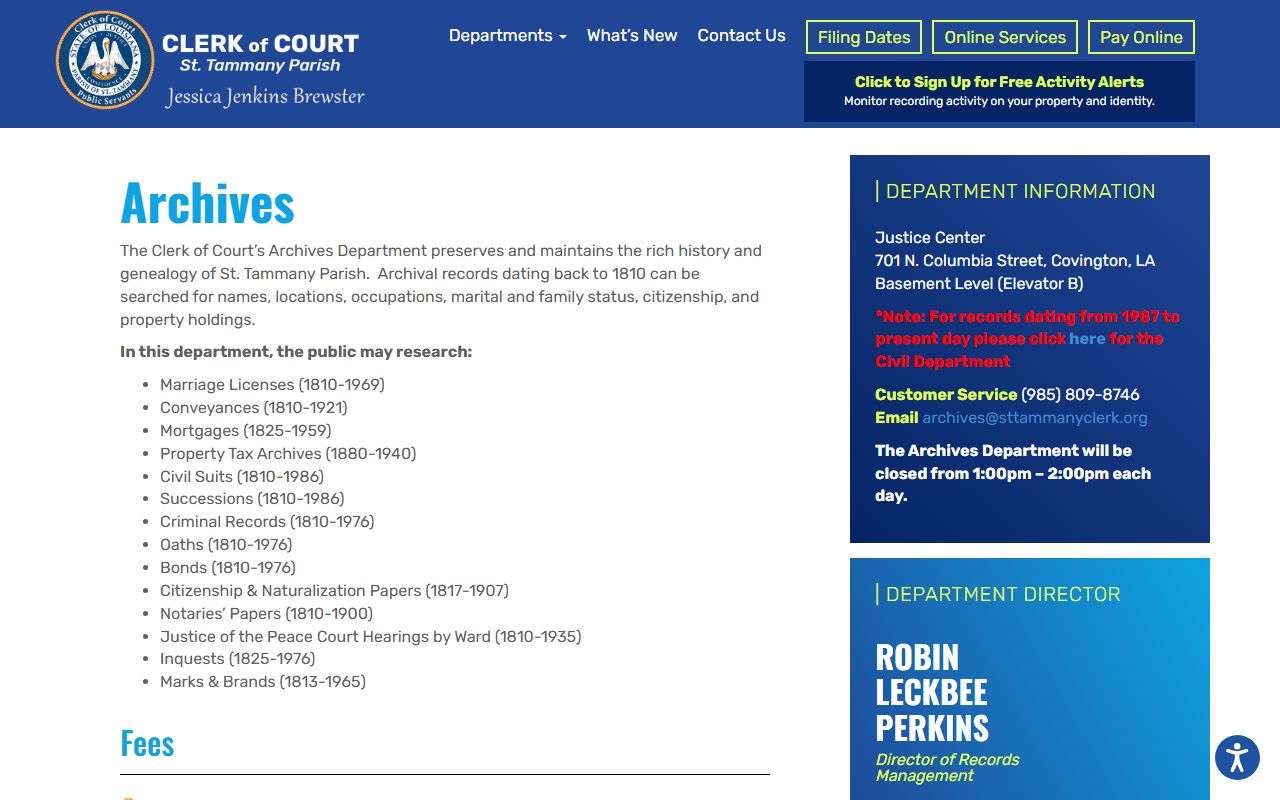
Archives can matter when a succession predates modern indexing or when the research goal is genealogy rather than a current certified court copy.
Probate Filing Fees
The research file did not locate exact St. Tammany Parish succession filing fees, certified-copy fees, or plain-copy fees in official HTML sources. The safe probate records approach is to confirm current charges with the Clerk Civil Department before filing or ordering copies. The Clerk's online-services page also links payment options and e-filing, but payment access is not the same as public record search.
| Item | Official status from research |
|---|---|
| Succession or tutorship filing | Amount not located in official HTML source; confirm with Civil Department. |
| Certified probate copy | Fee not located in research; certified copies come from the Clerk. |
| Plain copy | Fee not located in research; ask the owning Clerk department. |
| E-filing transaction | Account and transaction dependent through eClerksLA. |
| Recorded judgment of possession | May involve land-record recording or copy fees; confirm before ordering. |
Louisiana Code of Civil Procedure Article 253 is relevant to filing because the Clerk notes that most e-filed documents become originals once received, while some original legal documents cannot be e-filed under Article 253 and related electronic-record statutes.
The Article 253 source is included because probate-style filings are civil pleadings filed with the Clerk.
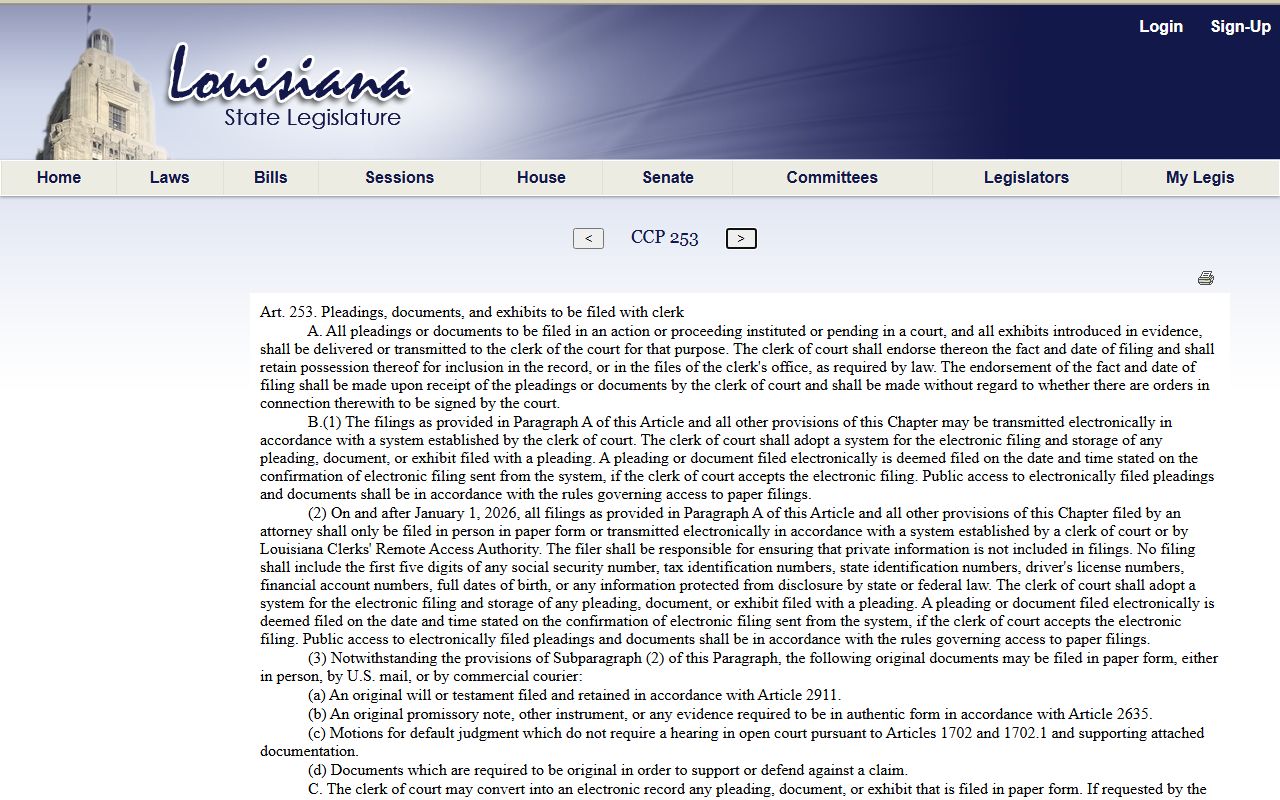
That filing rule helps explain why e-filing is useful for many succession papers but does not replace the Clerk's role as custodian of the official probate record.
What St. Tammany Probate Shows
A St. Tammany Parish probate record may show who filed the succession, the decedent name, attorney of record, case number, filing date, division assignment, heirs or legatees, documents filed, hearings, orders, and final judgment. If the estate includes immovable property, the land-record trail may show the judgment of possession as a recorded document. That document can be as important as the court docket because it links the succession outcome to real property transfer.
| Record piece | What it may show |
|---|---|
| Petition | Who opened the succession or tutorship and what relief was requested. |
| Will or codicil | Estate directions if the document was filed in the case. |
| Inventory or descriptive list | Estate property and values, subject to court rules and redactions. |
| Appointment paperwork | Executor, administrator, curator, or tutor authority when granted. |
| Judgment of possession | Final transfer of property to heirs or legatees, often needed for land issues. |
| Appeal record | Civil appeal activity if a succession or tutorship order is challenged. |
Certified copies are a Clerk function. Online views can help locate the right case, but legal use often requires a certified copy or e-certified copy from the Clerk rather than a screen print.
Restricted St. Tammany Probate
Not every civil filing is open in full. The research identifies adoptions, commitments, juvenile matters, sealed records, personal identifying information, and protective or emergency custody records as restricted categories. A tutorship involving a minor, a commitment-related filing, or a record with medical, financial, or minor identity information may be redacted or withheld even when a docket entry exists.
Louisiana public-records law supports inspection and copying of public records through the custodian, but exceptions still apply. For St. Tammany Parish probate records, that means the Clerk may be able to confirm the request channel without releasing every document to every requester. If a file is sealed or restricted, a party, attorney, or court order may be required.
Note: Public online access is a starting point, not a promise that every succession, tutorship, or supporting document can be viewed by anyone.